Edit database tables
like Vim buffers.
Dadbod Grip turns database tables into editable Vim buffers, with schema browsing, staged mutations, generated SQL, relationship navigation, and cross-database federation inside Neovim.
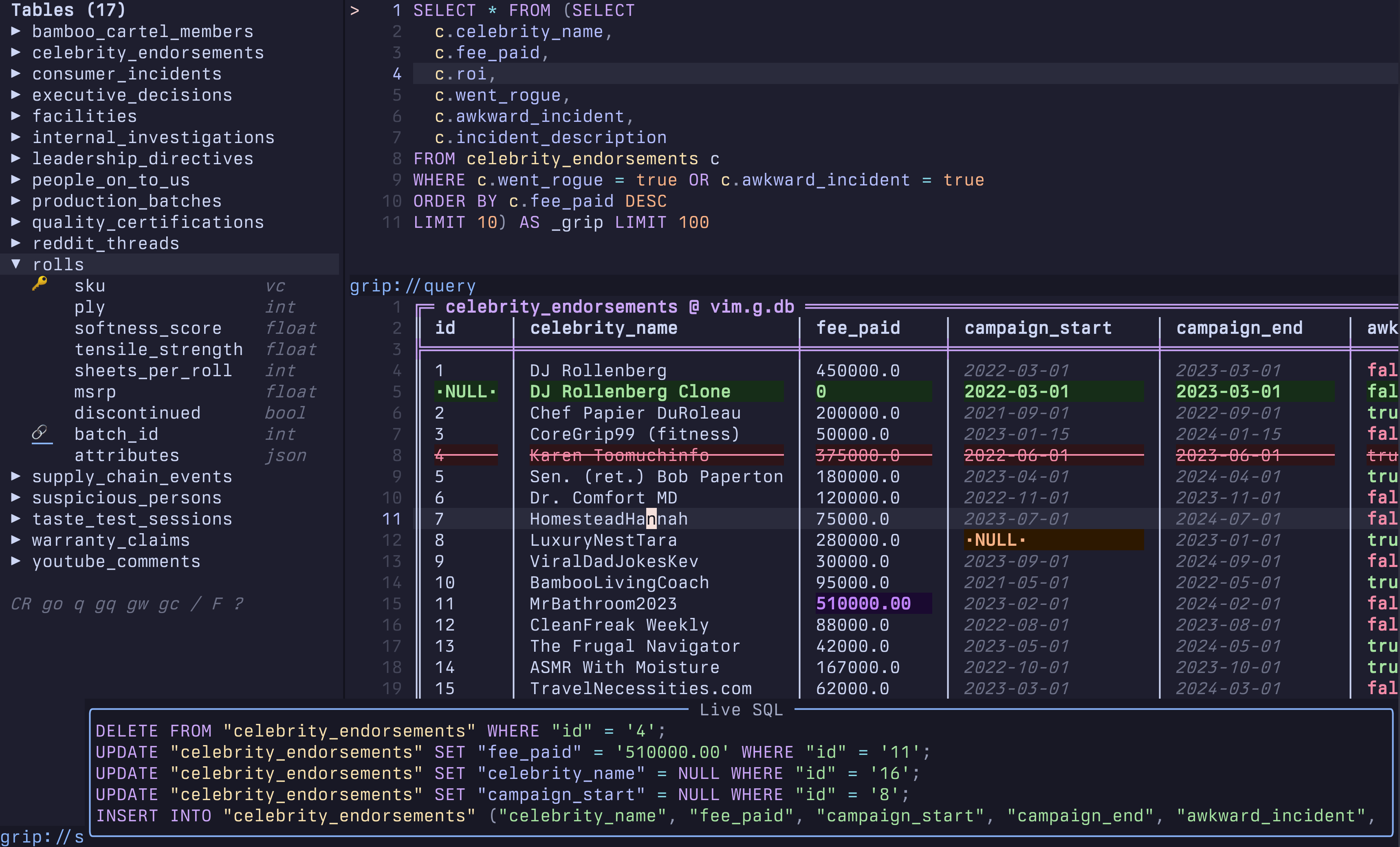
Review the write before it runs.
Every change stages before it touches the database. Review the SQL. Commit or cancel. The grid keeps investigation fast and makes the write visible before it runs.
-- 3 staged changes, waiting for `a` to apply

BEGIN;
UPDATE orders SET status = 'shipped' WHERE id = 42;
DELETE FROM orders WHERE id = 17;
INSERT INTO orders (customer_id, total) VALUES (88, 149.99);
COMMIT;
Click any cell. Delete a row. Insert one. Watch the SQL update live.
| id | name | status | total | |
|---|---|---|---|---|
| 42 | Alice Chen | pending | 149.99 | |
| 43 | Bob Park | shipped | 89.50 | |
| 44 | Carol Diaz | pending | 234.00 | |
| 45 | Dan Kim | returned | 67.25 | |
| 46 | Eve Lu | shipped | 412.80 |
The database work stays in one workspace.
Staged mutations stay visible.
Stage one change or fifty, then inspect the generated SQL. Dadbod Grip sends one BEGIN/COMMIT batch and keeps the staging state when the client reports an error, so you can inspect the database before retrying.
Editing docs →DuckDB joins the sources.
Use DuckDB as a hub for PostgreSQL, MySQL, SQLite, MotherDuck, local files, S3 objects, and HTTPS sources. SQL and attachment credentials travel through standard input instead of process arguments.
Federation docs →AI generates SQL, not approval.
A, or gA in the query pad,
sends the request, current SQL, and cached schema metadata to the configured provider.
The request travels through curl config on standard input. Generated SQL
returns for review and does not run automatically. Grid gA stages generated rows instead.
The rest of the workflow stays keyboard-native.
Editing
gA or :GripFill sends the active schema to the configured provider and stages its returned rows for review.:GripToggle closes or restores the Dadbod Grip windows.Navigation
gf follows an outgoing foreign key, gm follows incoming references, and <C-o> returns.1 through 9.<C-p> searches the actions available on the current surface.K turns the current row into a vertical key-value record.gG opens an ER map of the tables and their foreign-key relationships.Analysis
gR profiles distributions, completeness, and cardinality across the table.gQ turns an EXPLAIN plan into cost bars and heuristic index suggestions.gD compares two tables by primary key.s changes the primary sort, while S adds another sort tier.gF builds filters for equality, ranges, patterns, sets, and null values.gP saves the active filters, and gp restores a preset.gx opens an HTTP, HTTPS, or FTP URL from the current cell.Integration
picker option delegates supported lists to Telescope or snacks.nvim.gn opens a SQL notebook, and <C-CR> runs the block under the cursor.I/O
gE and gX export the current page or every filtered and sorted row.:GripOpen reads Parquet, CSV, JSON, Excel, ORC, Arrow, IPC, HTTPS, and S3 sources through DuckDB.gW reruns a file query on a timer while no edits are staged.g! enables write mode for supported local files.Query three databases in one statement
Attach any combination of databases to a DuckDB session. Every attachment gets a schema prefix. JOIN across them like they are local tables.
-- attach your sources
:GripAttach postgres:dbname=production host=db.internal user=app  prod
:GripAttach sqlite:archive.db  legacy
:GripAttach s3://my-bucket/enrichment.parquet  enrichment

-- then JOIN in the query pad (<C-CR> to run)
SELECT
  prod.customers.email,
  legacy.orders.total,
  enrichment.data.segment
FROM prod.customers
JOIN legacy.orders ON legacy.orders.customer_id = prod.customers.id
JOIN enrichment.data ON enrichment.data.email = prod.customers.email
Load the plugin with Lazy.
-- lazy.nvim
{ "joryeugene/dadbod-grip.nvim" }

-- then connect
:GripConnect